
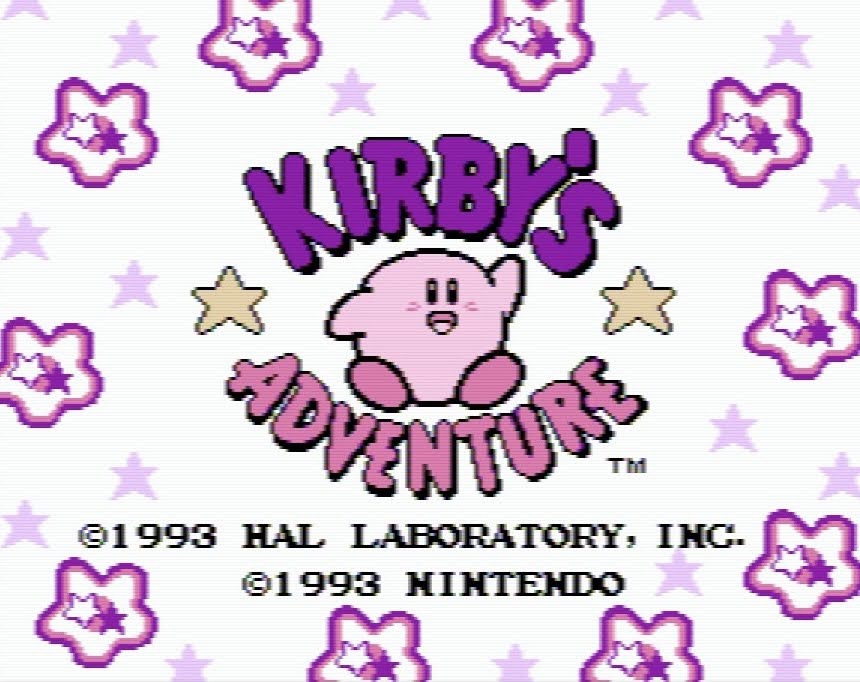
If you haven’t heard of Kirby then you’re probably not alone, this little pink blob of bubbliness seems to linger somewhere in the middle-ground of Nintendo’s healthy roster of notable characters. But after 30 years in gaming and 38 million units sold, the legacy of this puffball protagonist has proven that Kirby is anything but middle-rate. Aside from his basic design, Kirby is a complex sphere of abilities thanks to his knack for inhaling enemies and absorbing their powers. Using this premise to navigate simple 2D platform levels, this ability is the core mechanic of the Kirby games and sets them apart from other titles in the genre.
I first came across Kirby during his debut outing in Kirby’s Dreamland (1992) for the famously awesome, Gameboy. As a nerdy twelve year-old I seemed strangely drawn towards a character that could ‘suck’ his enemies into oblivion, and while that might seem like the tip of some Freudian ice-berg, it should be worth noting that Kirby doesn’t technically suck anyway, he inhales. Nonetheless, the idea of a character that could essentially ingest enemies seemed so completely unique to me at the time that I needed to own the game. And, as if my own dreamland were being made real, I got it. I remember that game very fondly, and as such, MiSSEDiT is gonna have to miss out on reviewing the first instalment of Kirby’s adventures. My nostalgiometer is already registering over 9,000 nostalgians cuddling my mind at the very thought of my dear Gameboy and the things I played on it.
However, I never played another Kirby title after that first one until the super-happy-fun people at Nintendo kindly made Kirby’s first home-console outing available on the Switch NES emulator. Kirby’s Adventure was released on the NES in 1993 and now, thanks to the tech of knowledgey, it descends through time, space and bandwidth onto my home machine for the appraisal and recognition of future gamers.
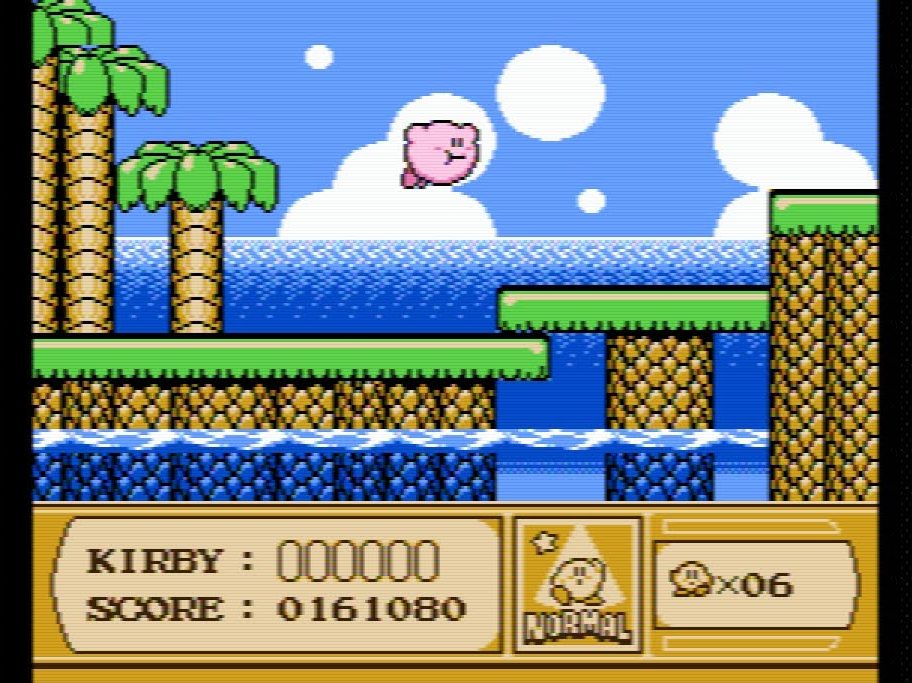
Despite having played it’s predecessor on a weaker console, I think it’s fair to say that I didn’t have much expectation of what this game would be like. The last time I played a Kirby game was 30 years ago after all, and I can barely remember what happened 30 minutes ago. Therefore, there was nothing to colour my surprise at just how instantly lovely this title is. If this game were food, it would be marshmallows and ice-cream with sprinkles and raspberry sauce, mountains of the stuff, simple, sweet and easy to enjoy. With it’s large colourful sprites and the fluffy aesthetic of the Dreamland setting I found myself yearning to play this game while resting in a big, comfy pillow nest, eating a bag of sweets and drinking a hot-choc.
First up then, the graphics. Well ain’t they a treat? Gorgeous cartoon backdrops, big sprites and bright yummy colours that envelop you in a world of cuddles, clouds and candies. Kirby himself is a simple design, but he’s a cute little pudge ball that sits right at home in the family-friendly, cartoonish scenes. The animation is slick and offers no resistance to quick, runny gameplay, and there were some surprising graphical tricks employed during certain stages of the game that I really hadn’t expected. The parallax-scrolling used on the tower scenes in the “Butter Building” world actually left me feeling impressed that a traditionally 16-bit trick had been squeezed so expertly out of an 8-bit piece of hardware.
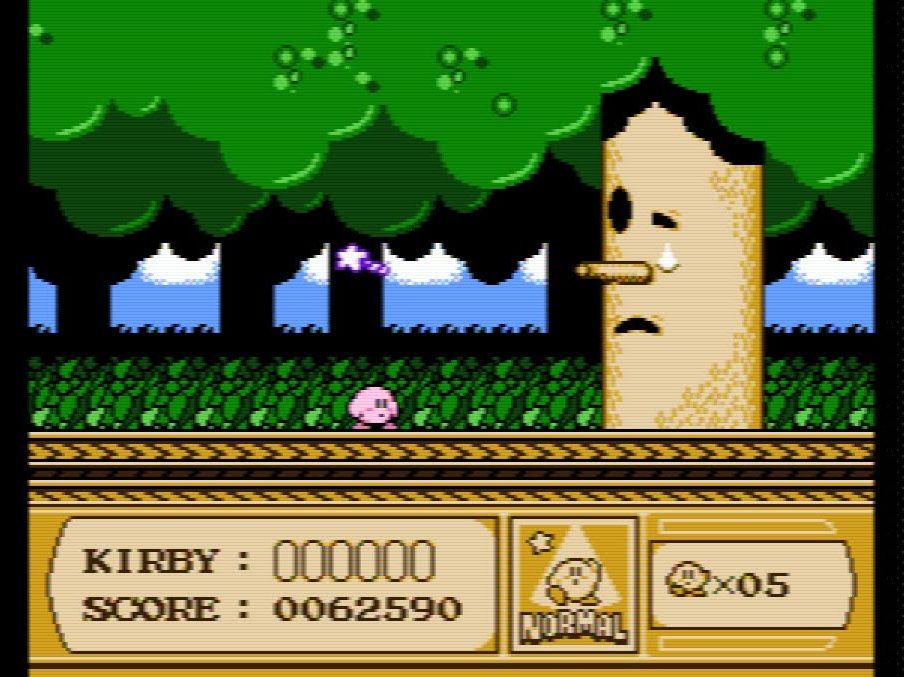
The colourful and vibrant graphics mirrored the level design, with an emphasis on fun rather than challenge. While some could complain that the game is too easy there’s more to the missions than just eye candy and bouncing about. Often the challenge of the level is not just to finish it, but to find everything along the way. And to this end, what also struck me was the variety of ways in which you can approach the various enemies and obstacles that try to squash your progress.
This was the first Kirby game that not only allowed you to inhale your enemies, but to absorb their abilities and change Kirby’s offensive or defensive capabilities. And there’s a great deal of variety on offer in the types of attack and defense you can equip your bouncy blob with. For a two-button title I found it quite a blessing that the gameplay permitted such an incredible assortment of ways to play.
It’s really quite special to find a game from this era that offers this level of flexibility with it’s playable character, and these abilities can also make the difference between finishing the level and finding every little secret hidden therein. This flavours Kirby with the sweet zing of replayability in what might seem like an overly simple game. But it’s that simplicity that brings you back for more, the lack of frustratingly difficult levels means that you’re more than happy to jump into a stage over and over to try and get to the secret bit you couldn’t quite reach before, or just to see what the new ability you’ve found in the museum can do. It’s a game that encourages play for the sheer fun of it, not necessarily just the challenge.
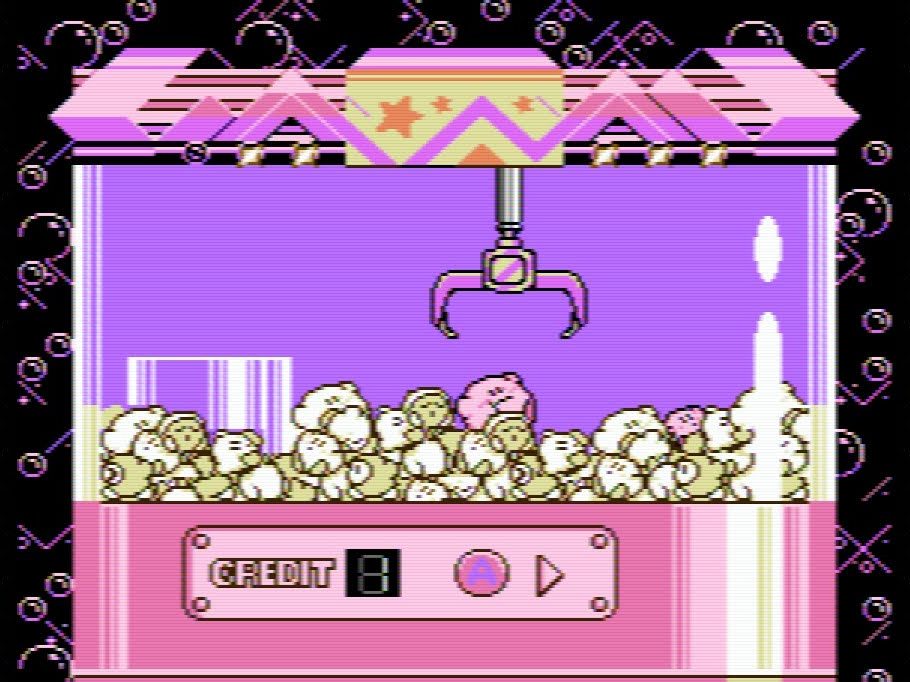
Erm, so “museum” you say? Correct, Kirby is one of those wonderful 2D platformers, like Super Mario Bros. 3 before it, that features an ‘overworld’ lobby or map area that you navigate between stages. I love a good overworld and here it’s used to perfect effect by adding an extra dimension of adventure to a game that is essentially just a level-by-level sprint to the finish. This overworld serves to expand the game out from the traditional linear level progression of 2D platformers by offering up a variety of distractions in the form of mini-games, ability ‘museums’ and even a battle arena. These interim areas are a fun way to gain new abilities, extra-lives and blow off steam if you don’t fancy just plodding on with the next level.
As a 2D platformer though, all Kirby needs to offer is a side-scrolling hop, skip and jump to the finish-line of each level and it ticks this box with flair. Kirby’s movement in-game is fluid and fun and the controls translate well to the Switch’s analog sticks. Even if you ignore the side amusements, there’s plenty to enjoy here, with unique and wacky boss fights and a whopping 41 levels across 7 beautifully animated worlds.
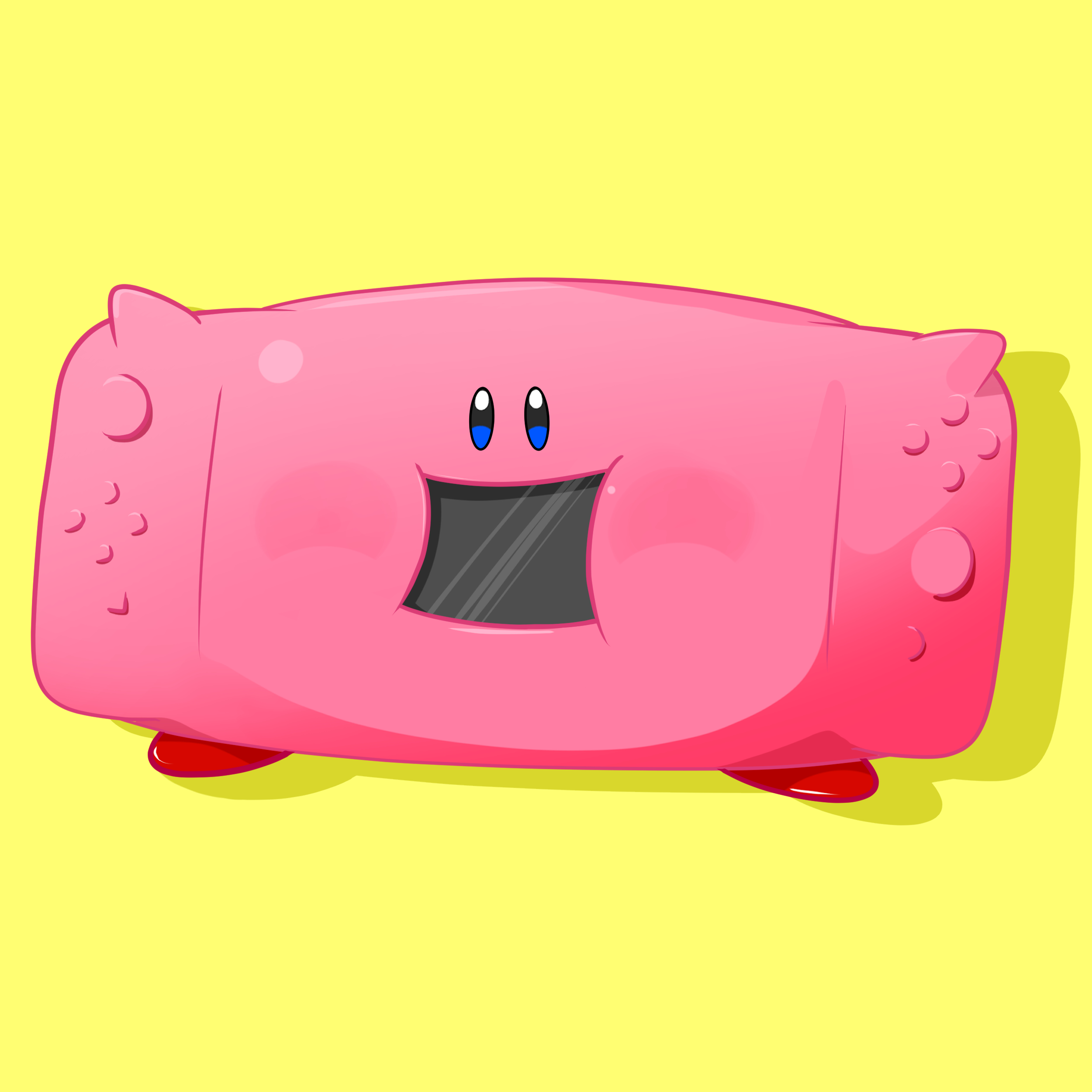
After playing through Metroid and The Legend of Zelda, I began to doubt if any of these ‘classics’ were going to be decent enough to enjoy, but Kirby inhaled those doubts, quashed them and puffed them back out as a fluffy magic star. This game is a treat of colour and fun, a vibrant platformer that is packed with features, levels and gameplay variety, and is just as playable and enjoyable now as it would have been back in the day. In fact, playing this ancient 30 year-old game now has directly influenced my decision to try out the latest offering in the series in Kirby and the Forgotten Land on Nintendo Switch (2022), and I fully intend on returning to Dreamland whenever I get the chance to review another of these classic titles for MiSSEDiT in the future.
Verdict:
 MiSSEDiT