

Rarely does a game come along that is so influential an entire genre is named after it. Then suddenly two come along at once. Along with Castlevania, Metroid helped spawn the Metroidvania line of gaming that relies on exploration, action and adventure to entertain gamers well into the modern era. Recent popular releases like Ori and the Will of the Wisps and Hollow Knight owe their very DNA to this earliest incarnation of their lineage, and yet one must ask the question; Is Metroid a good metroidvania game?
It’s also important to remember that we’re asking this question on behalf of MiSSEDiT, and as much as people love this game for what it was back in the day, we’re not taking nostalgia, legacy or importance into consideration. We care about what it’s like to play this game for the first time now, right this second, in the twenty-first century.
So, how did it do?
Well, you could say I really missed out on this title as a kid. Not necessarily because it’s a great game, but because Metroid is a sci-fi horror title directly inspired by Ridley Scott’s original 1979 Alien movie. And I loved Alien.
But I couldn’t afford this game because my family spent all our money on Soda-Streams and Care Bears.
So here we are, nearly forty years after its first release, finally getting the chance to play it on my Switch and find out if it took to it’s own genre like a duck to pancakes.
First up then, I hate to sound like a broken record, but where’s the goddamn map? I have to ask because I’m hot-off-the-heels of reviewing The Legend of Zelda and found the lack of a map scratched my nads like a fucked-off cat. But at least Zelda gave you a detailed, albeit, half-complete map in the manual. There’s no such luck with Metroid. Metroid starts you off in the middle of some environment and…off you go!
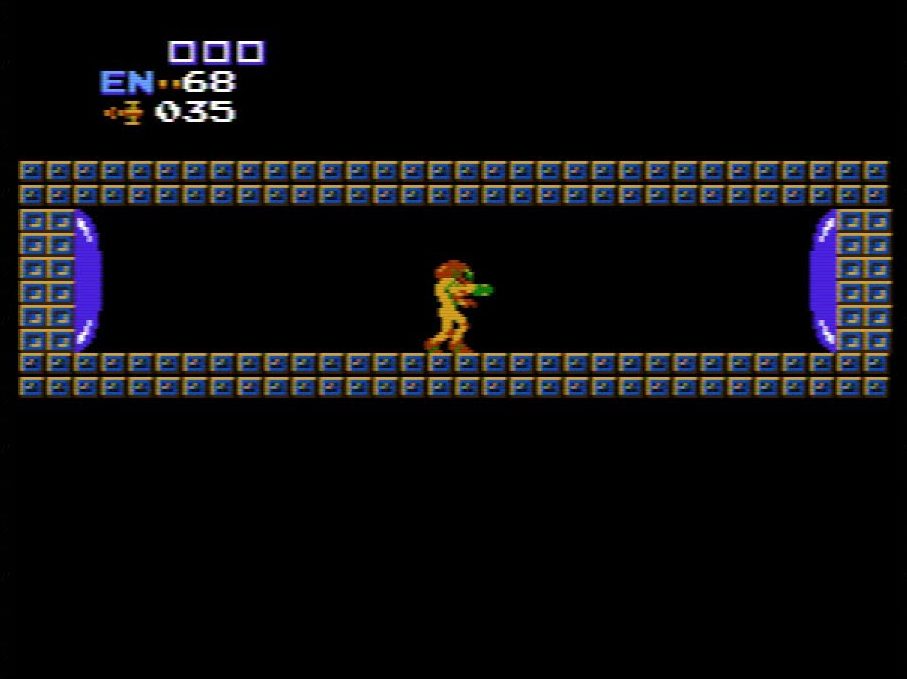
But there’s no way of really knowing where you’re going, where to go next, or more importantly, where you’ve been. Sigh. For those uninitiated I should take this opportunity to clarify what a metroidvania game actually is. Contrary to a typical arcade action title that features level-by-level progression triggered by finishing one stage and moving on to the next, metroidvania games make a whole 2D platforming game-world available from the outset, one giant level that requires a search for items and upgrades that allow you to reach or access parts that you found previously inaccessible. Continued exploration will open up other abilities and upgrades that you don’t even need in order to finish the game, but they might make the task that little bit easier if you have the will to try. It’s this focus on exploring an open world and upgrading your character’s abilities that make these games what they are.
But as you can imagine, exploring is often more enjoyable if you have a map to give you an idea of where you’ve been already. But again I found myself playing a game that required me to make my own.
Well fuck that.
This is 2022 dammit! I have maps at my fingertips for everything from going to work in the city, to clambering through brambles in the Scottish-highlands. I don’t want to scribble my own shitty effort on to the back of a pizza box. I don’t know if the omission of this basic function is a limitation of the system or an in-built game mechanic, but whatever led to its absence, I hate it.
Maps aside, the game might have been easier to navigate had each screen been distinctive enough to be memorable. This could have helped me form a mental map in my feeble brain based on visual cues. But many of the screens in Metroid are maddeningly similar, you walk through a door only to find the same screen you’ve just seen through the previous two. This makes it vexingly difficult to tell if you’ve been there already. To make matters worse there are various areas that can only be accessed by randomly bombing or shooting walls to open secret passages. And this all became a huge barrier to enjoying what might have otherwise been a decent game.
Despite the fact that certain screens have the same layout, the graphics are passable for the capabilities of the system. The developers utilised the NES’s 56 colour palette to ensure that each ‘world’ had a distinctive character, distinguishing it from the other areas of the game. As a result, you might not know if you’d visited a specific corridor already or not, but you could at least tell when you were in a new general area. The design of the enemies was not quite as well thought out though and they weigh-in a little under-whelming, they don’t look like anything in particular and range in difficulty from pointless cannon-fodder to seriously annoying.
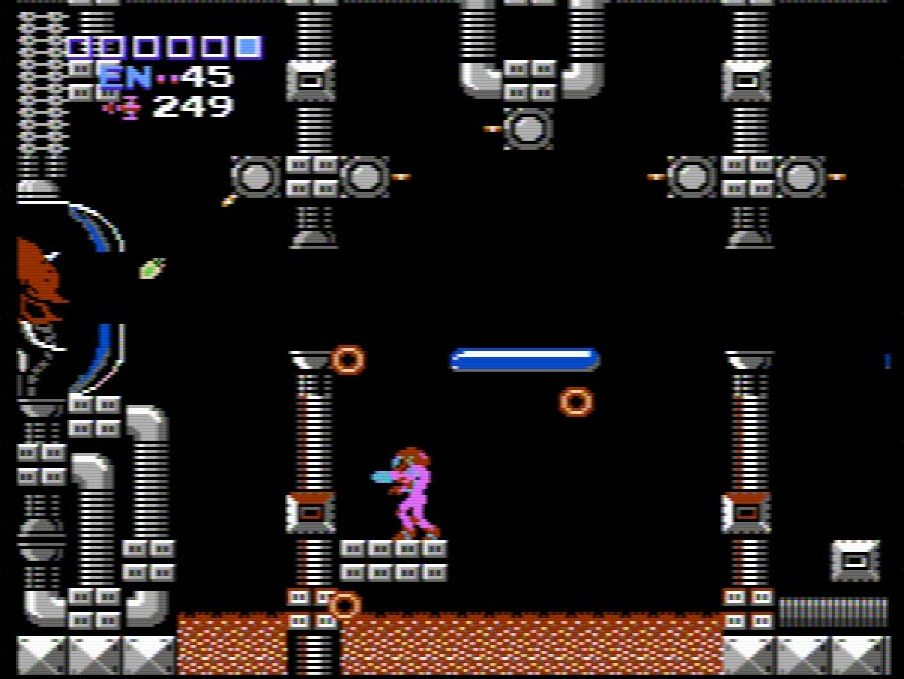
The saving grace of the character design, however, was the playable character, Samus Aran. Here was a slick and large sprite with a great sci-fi aesthetic. This mysterious and almost alien character allowed the player to apply their own identity onto the faceless visage of a space-marine on a mission to save the galaxy.
The sound design is also worth a positive mention. It’s good. That’s it, move along. No. Really, from the outset you’re presented with a rather standard ‘hero’ theme that typifies the action/arcade genre, but in certain sections the tone shifts into a more discordant style that intensifies the games sense of loneliness. These sections really hone that isolation that the developers wanted to impress on the gamer, and an atmosphere that has a palpable malevolence.
This solitary ambience is beneficial to the game, but it comes at the cost of in-game narrative. With no NPC’s to interact with, and no real story to follow, there’s an absence at the very core of Metroid that makes it feel kind of pointless, and while you could argue that it isn’t necessary, it would be a welcome embellishment to what is an otherwise atmospheric game-world.
Many games from this era lacked narrative, and it can hardly be said that the game is ruined because of it, but the size and vastness of the world feel like they could hold some dark undercurrent of secrets and stories rather than just a run-and-gun mission to kill the shit out of everything.
But then it was the 80’s.
The game designers at least make this mission fun. The movement of Samus is fluid in a way that was quite satisfying, the jumping, rolling and running don’t feel clunky or contrived, they feel natural and instinctual from the start. The movement maps fairly well to the Switch’s analogue sticks and I had none of the problems I’d experienced previously while playing through Zelda. (See my Zelda review for more info.) The shooting is multi-directional, and although a weak range is initially a problem, upgrades soon see your firepower grow into a varied arsenal of goodies. This need to upgrade forces you to search for power-ups around the environment and collecting them is not only a means of empowering your character against stronger enemies, but it opens up parts of the game-world that were previously unavailable. It’s a progression system that is both familiar and rewarding.
And then the big reveal! Spoilers!! If you’ve lived under a moon-rock for the last forty years you’ll be forgiven for not knowing that completing this game in the correct way reveals that the hero of the game is actually, drum rooooooooll…a heroine! You might not think that’s a big deal nowadays, but this was progressive as fuck for a sci-fi action game in the mid 80’s. Irrespective of the fact that the reveal shows that Samus, under all her armour, is wearing a pink bikini and kinky boots, this still feels like a significant step toward adding diversity into a traditionally male dominated role.
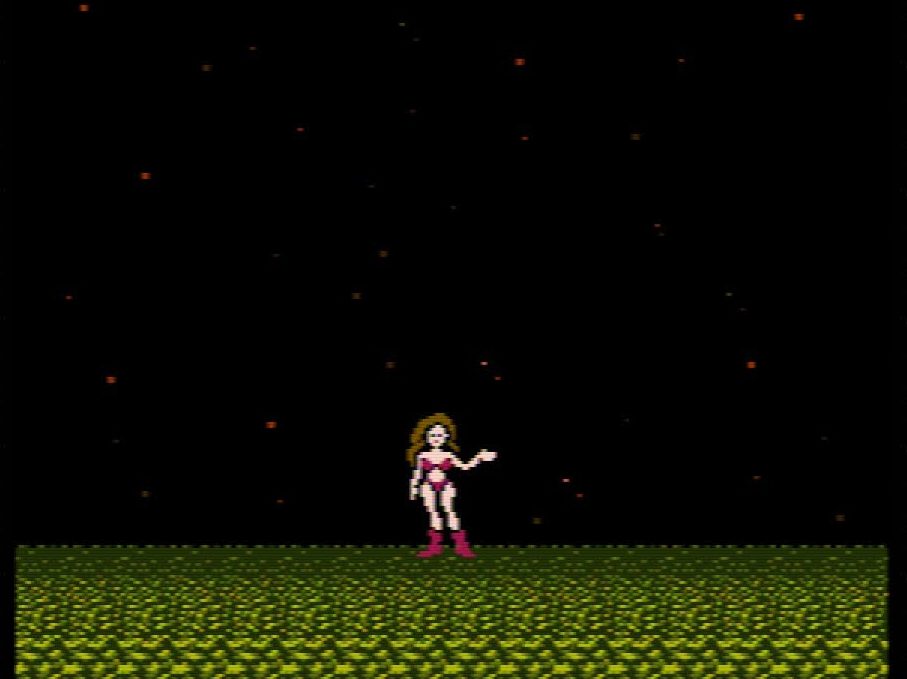
In that respect, Metroid is very much a metroidvania game, by subverting expectations, it took the traditional arcade formula and turned it inside-out, flipped gender-roles and rewarded exploration over linear progression. Albeit in its simplest form. But the downsides of this title remain barriers to true enjoyment, the boring or annoying enemies, the samey screens and the lack of a map create a game that feels inaccessible and frustratingly difficult. Which is a shame, because there’s a somewhat decent game hiding in the shadows if only you’d care to look.
Verdict:
 MiSSEDiT
One response to “Metroid (NES 1986)”
[…] playing through Metroid and The Legend of Zelda, I began to doubt if any of these ‘classics’ were going to be decent […]
LikeLiked by 1 person